software-engineering
The Next Panel: Why AI Isn't the Death of Craftsmanship
Every generation believes it is witnessing the death of real craftsmanship to new tools. History shows the tools change, but the core of the craft simply moves elsewhere.
The Next Panel: Why AI Isn't the Death of Craftsmanship
Every generation is convinced it invented the end of craftsmanship. None of them did.
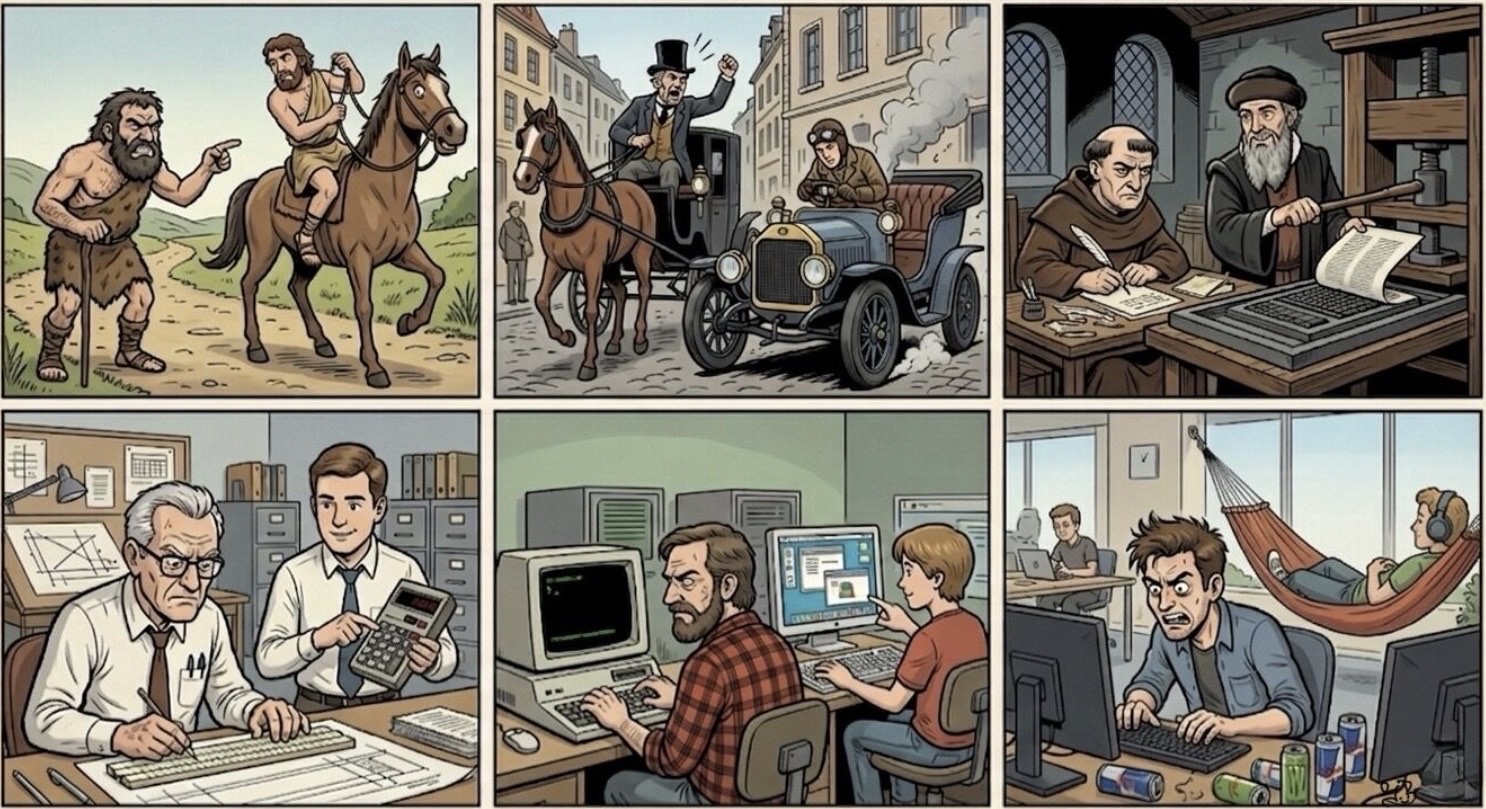
There’s a cartoon making the rounds: a caveman scolding the man who dared to ride a horse instead of walking, a carriage driver shaking his fist at the first automobile, a monk glaring at the printing press, an engineer eyeing a pocket calculator like it’s a form of cheating, a father squinting at a screen his kid navigates without thinking. Six panels, same scene, a few thousand years apart.
The last panel is a developer surrounded by energy drinks, glaring at the colleague in the hammock who just let the tools do the work. That one is us. Right now.
The Pattern of Resistance
What strikes me is that none of the complainers were stupid. The monk was right that the printing press would flatten something—the patience, the individual hand, the years it took to get good at copying. He just had the verdict wrong. The press didn’t kill writing; it moved the part worth caring about somewhere else, and the people who noticed where it went did fine.
The pocket calculator didn’t make arithmetic worthless either. It turned “what are you actually trying to compute” into the whole job.
Where Do We Stand?
So when I watch someone hand the boring 80 percent to an AI agent, I try not to be the man holding the calculator and calling it cheating. Not because resisting is wrong, exactly. It’s just that the resisters are always in the picture, and never in the next panel.
The uncomfortable part is that I can’t be sure which panel I’m standing in either. Nobody in that cartoon could.