ai
The Prompt That Talked Itself Out of a Job
I built a stock-analysis prompt in PUCO, then asked it which part actually needed a model. The honest answer was: none of it — so, from inside the same prompt, it built me a plain dockerised FastAPI app that runs on zero tokens.
Sometimes the most useful thing a prompt does is show you that you didn't need the prompt.
I built one in PUCO (puco.app) to analyse stocks and ETFs — you type a ticker, and out comes a tidy breakdown. For the occasional look it is genuinely good. But once I started working through a handful of names in a row, two things became clear: it costs tokens (negligible, in the end) and, more to the point, it is slow.
The part that didn't need a model
So I asked myself which part of that prompt actually needs a model. I talked it through with ChatGPT, and the answer was mildly deflating: none of it. The model wasn't analysing anything. It was fetching deterministic data, aggregating it, and pouring the result into an HTML page. Honest work, but not work that requires intelligence.
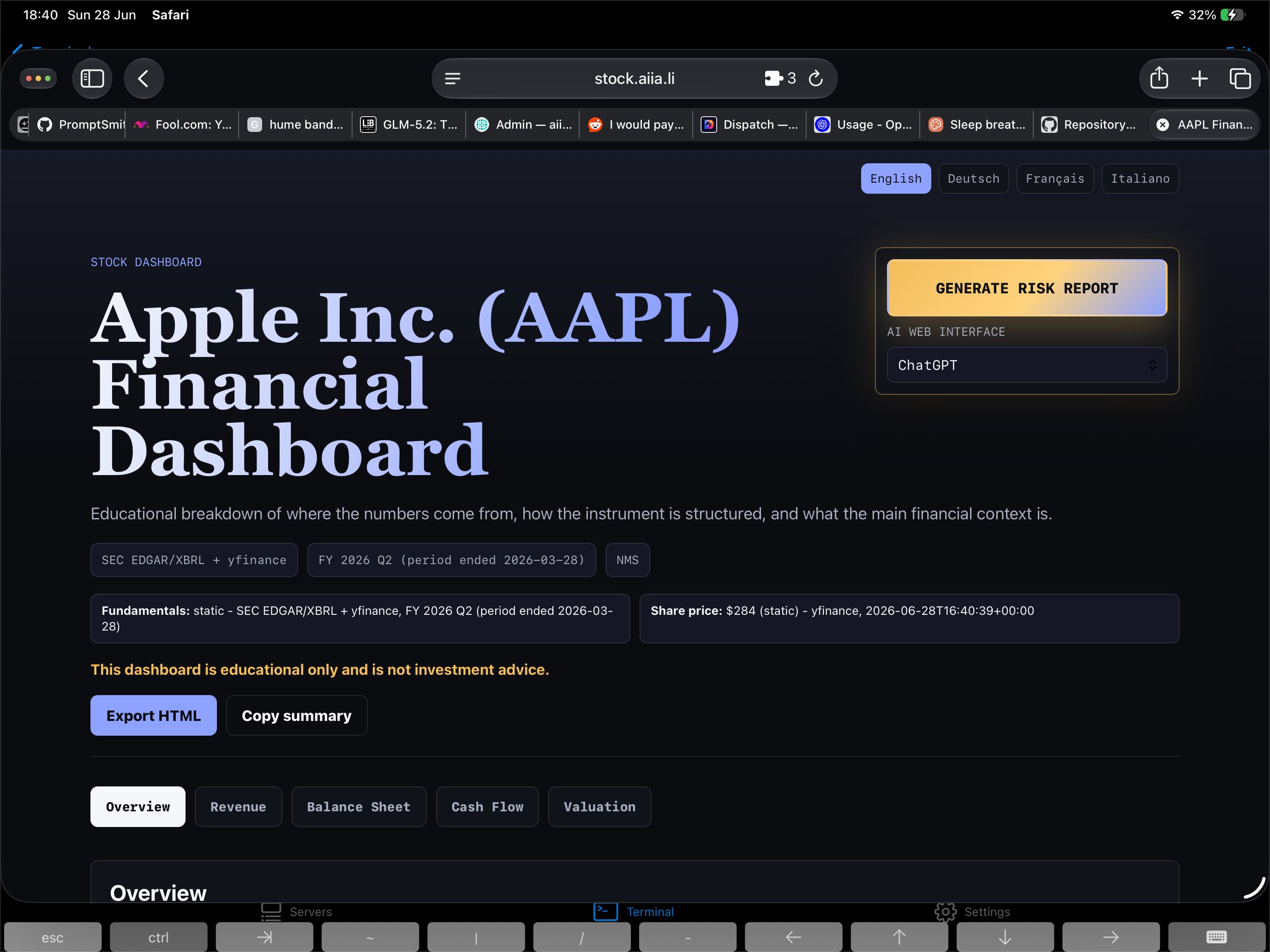
So I did the obvious thing, from inside the very same prompt: I asked it to build me the whole thing without AI — Python, dockerised, deterministic. A small FastAPI app came back. And because every PUCO prompt carries a target-language instruction, the app arrived already localised for all of Switzerland (German, French, Italian — and, for the rest of us, English).
It is fast, it is dynamic, and it burns exactly zero tokens per run.
Prompts get you to the idea, not to the thing you ship
The lesson I keep relearning: prompts are excellent at getting you to an idea. They are not always the thing you ship. Use AI for the creative part — the part where you don't yet know what you want — and then, when you do know, build it the boring conventional way.
And maybe that is the quiet case for PUCO too. Not everyone needs a prompt database. But a good prompt you would never have written yourself — one that comes from outside your own subjects entirely — can still send you somewhere useful. That is what PUCO, now on the web as well, is rather good at: handing you a starting point you didn't know you were looking for, and letting you see what is possible before you decide whether it is worth keeping.
Where do you draw that line — AI for thinking, plain code for running?