ai
My Brainchild, Written by Someone Else
When people ask whether my articles are written by AI, I say yes. Whose article it is, is another question, and the answer is older than any language model.
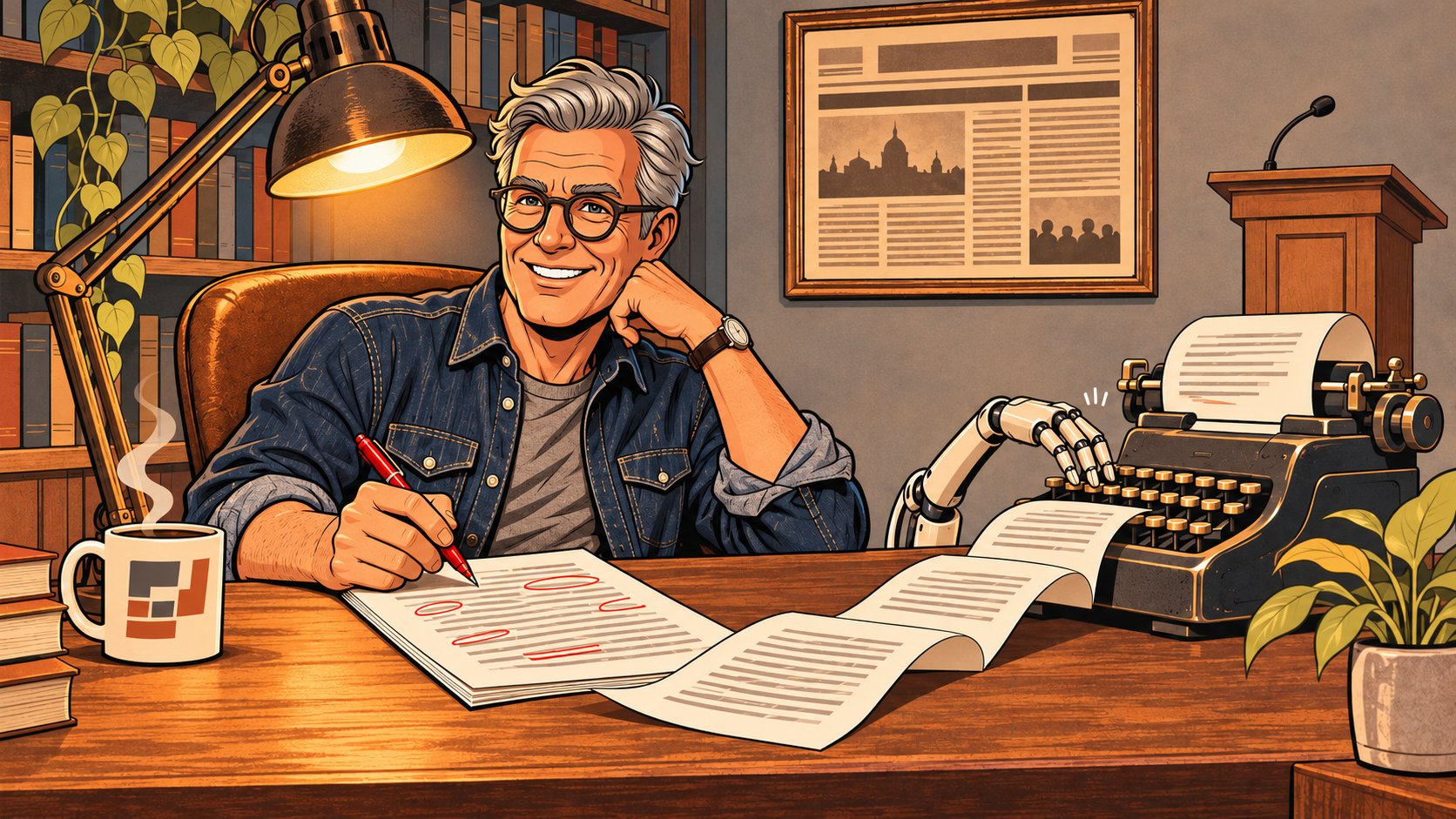
Hardly any politician writes their own speeches. Nobody calls it fraud.
A Swiss Federal Councillor's National Day speech is often drafted in an office full of people whose names you will never learn, and still nobody would think of saying it isn't hers. She delivered it, she stands by what it says, and if a sentence misfires, she is the one explaining it the next morning, not the person who typed it. For decades that was a perfectly adequate definition of authorship. The question only turned philosophical once one of the people involved stopped being a person.
The honest answer
When someone asks whether my articles are AI-generated, my answer is: yes, an AI wrote them. The idea, on the other hand, is mine. I let my thoughts run freely, usually dictated and correspondingly untidy, and the AI shapes them into whatever the place calls for: short on LinkedIn, more detailed on my own website.
The objection follows with great reliability: then you didn't write it yourself. True. Then again, that was never quite the case before either. It just didn't interest anyone.
Authorship was always shared
I used to work as a journalist, and there was always a copy desk behind me. Had anyone asked whether an article was exactly as I had written it, the honest answer would have been no, because the desk cut, rearranged and occasionally put headlines on top that I would never have written. The idea usually wasn't mine to begin with either; it came from the editor-in-chief, who had an assignment and, conveniently, me to go with it. My part was how I approached it: which questions, which tone, which stance. My name still went on top.
Today the roles have almost reversed. I supply the occasion, the stance and, at the end, the sign-off, and the AI is the hand that turns it into sentences. Anyone who had no problem with my articles passing through several hands back then would have to explain why it should now depend on what kind of hand it is.
What stays with me
Two decisions I do not hand over. The first happens in conversation: the AI tests counterpoints, asks whether it might not be entirely different, and I decide whether an objection holds up in my own understanding. The second happens at the end: a text only goes out if it matches what I think. Not every word has to come from me, but every claim has to be mine.
On top of that there is a skill I gave the AI at some point, built from texts I wrote myself. It knows my sentence structure, my way of explaining things and my sense of humour, which tends to be quiet (whether the AI gets it better than I do on my bad days is a question I prefer to leave open). That is roughly what a good speechwriter carries in their head after a few years.
An example from very close by
What this looks like in practice is shown by how this article came about. I dictated the idea, with the copy desk as the central argument. The AI pushed back: back then, my name was on the article and not the editor-in-chief's, even though the idea came from there, so by that logic the AI should be in the byline today. I tested the objection, accepted part of it, and the argument got sharper for it. That went on over several conversations.
The speech comparison this text opens with, incidentally, came from the AI. I thought it was better than mine and took it, which, if you think about it, is exactly what a Federal Councillor does with a good suggestion from her speechwriter. A ghostwriter rarely contradicts the client, by the way. A good copy desk does it all the time.
So, did I write it?
An AI wrote this article. I started it, let it argue with me, checked it and signed it off, and I stand behind every sentence in it.
Did I write it myself? No. Is it my article? Yes. It is my brainchild, and children, as is well known, rarely say exactly what you told them to say, but rather what you gave them along the way.