llm
The Cheapest Model That Only Has to Write Text
Picking an LLM is rarely a knowledge problem. It is a filtering problem, and until you have the filter, the answer sits in five browser tabs that disagree with each other.
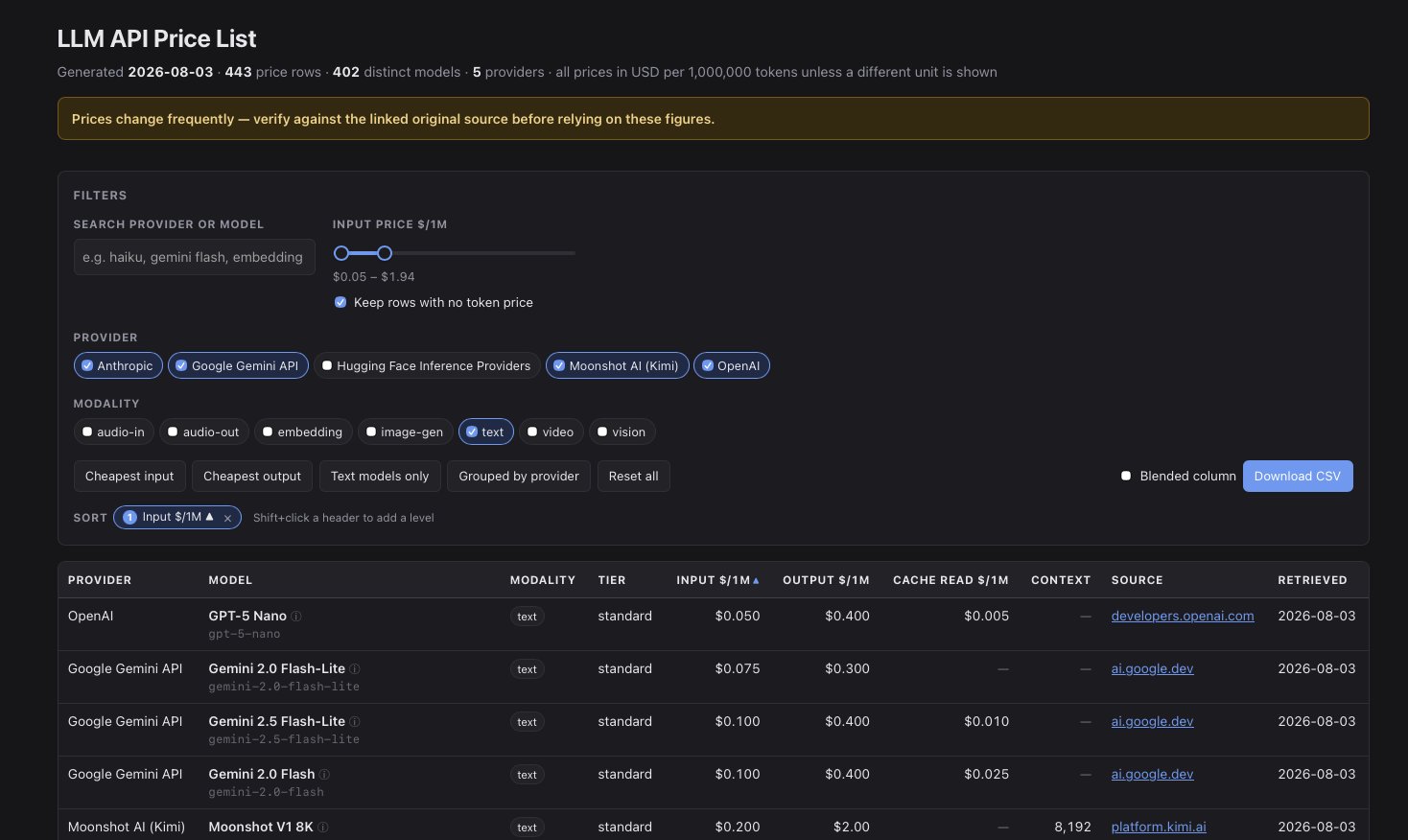
Name the cheapest model that only needs to produce text. Not the best one, not the one everyone is posting about this week, just the cheapest one that can write a paragraph and has no business looking at images. You probably can't, at least not without twenty minutes of moving between five provider pages, each with its own table layout, its own footnotes, and its own idea of what a price even is.
I did that often enough to notice that I was doing it, which is usually the point at which I stop doing it and build something instead. With a couple of agents doing the fetching and the tedious parts, the tool took less time than the research it replaces, which says something about both the tool and the research.
What is in the list
443 price rows, 402 distinct models, five providers: OpenAI, Anthropic, the Google Gemini API, Hugging Face Inference Providers, and Moonshot AI (Kimi). The snapshot I am looking at was generated on 3 August 2026 at 13:45 UTC, and that timestamp sits visibly on the page, because a price list without a date is a rumour.
Everything is USD per one million tokens, unless a row uses a different unit, in which case the row says so rather than quietly pretending otherwise. Each row carries provider, model name, model ID, modality, pricing tier, input and output price, the cache-read price where a provider publishes one, the context window, the original source URL, the retrieval date, and a confidence level.
The part that actually saves time
Back to the opening question. Preset "cheapest input", filter the modality to text, hide the rows that have no token pricing at all, and those 402 models collapse into a short list you can read in one sitting. That is the whole trick. It is not clever, it is just work that somebody had to do once so that nobody has to do it again on a Tuesday afternoon.
Beyond that: search by provider or by model, filter by input-price range, combine provider and modality, or reach for the presets for cheapest input, cheapest output, text-only models, and grouping by provider. Every column sorts. If you would rather finish the job in a spreadsheet, there is a CSV export.
Two columns that exist because the raw numbers mislead
The first is an optional blended price: three parts input plus one part output, divided by four. A model with a friendly input price and a brutal output price looks excellent in a table sorted by input, right up until the invoice arrives, and the 3:1 weighting is a rough stand-in for traffic where you send more than you receive.
The second is a monthly cost calculator: input tokens per request, output tokens per request, requests per month. "USD per million tokens" is not a unit anyone has an intuition for. A monthly figure is, and it tends to end arguments faster.
What the list deliberately does not do
The baseline is pay-as-you-go, standard tier. No volume discounts. Batch discounts are stored separately rather than folded into the displayed rate, because a quietly discounted number in the main column would flatter whichever provider happens to offer batching, and that is not a comparison, that is marketing.
Each row carries a confidence level, and anything medium or unknown comes with a note saying why. Each row also links its original source together with the date it was retrieved. Prices move often enough that you should check the source before you commit a budget to it ... the list gets you to the right three candidates, not to a signed contract.
That is roughly the deal I am willing to offer. Not certainty, just a much shorter list, arrived at in about fifteen seconds instead of twenty minutes.
The list is here, and it gets regenerated regularly:
- English: https://aiia.li/en/tools/llm-api-price-list/
- German: https://aiia.li/de/tools/llm-api-price-list/