crypto-trading
The 2 A.M. Trap: Why Crypto Trading is Behavioral Science, Not Math
Most people treat crypto trading as a math problem, but building an automated DEX whale-watcher proves it's actually a behavioral experiment with real money attached.
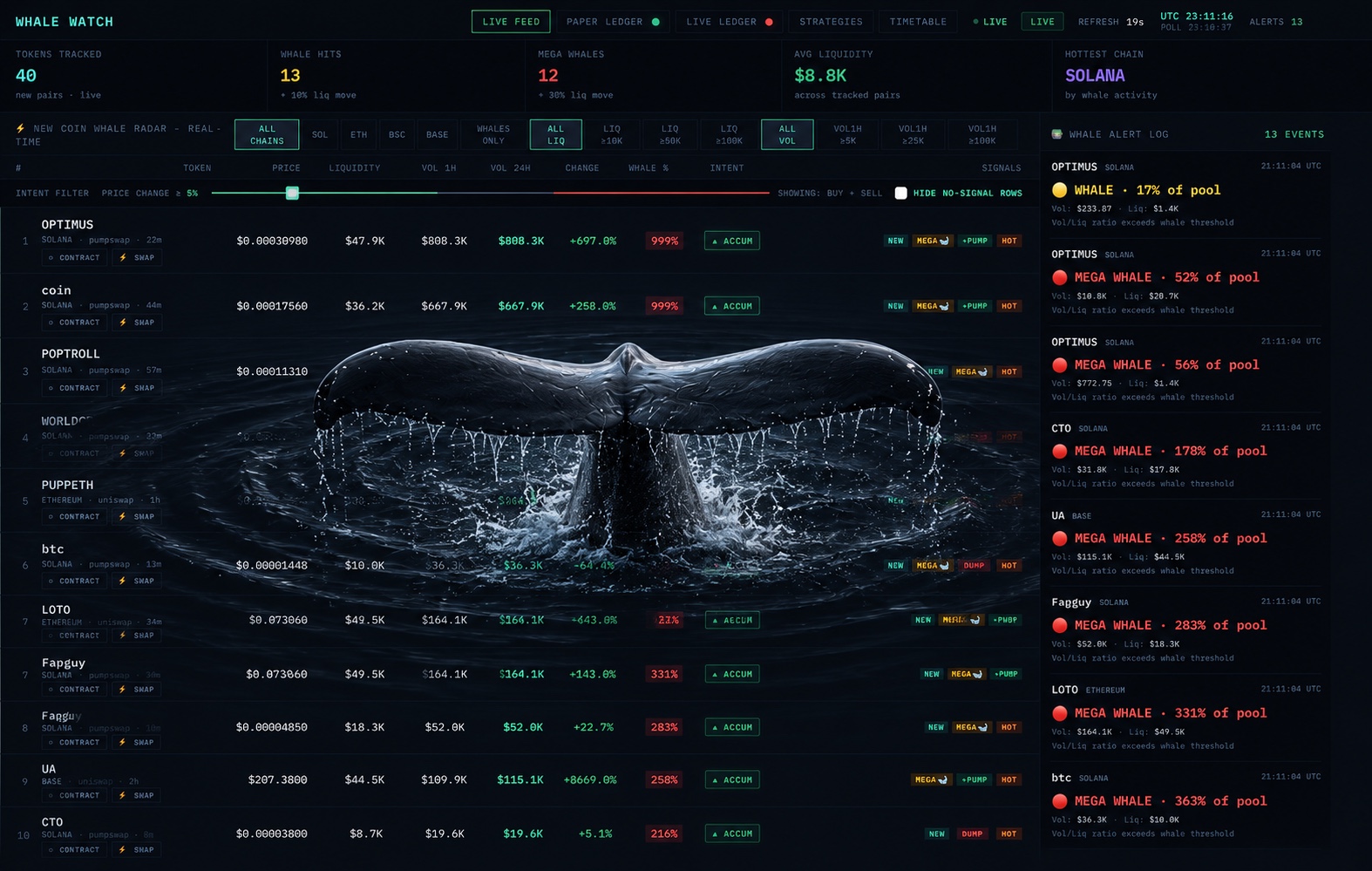
Upstream Signal, Downstream Charts
Most people treat crypto trading as a math problem. It might be closer to a behavioral science experiment with money attached.
I’ve been building a whale watcher for newly launched DEX tokens, and the longer I run it, the more it confirms a quiet suspicion I had from the start: this game has very little to do with financial knowledge and almost everything to do with human nature. Greed, fear of missing out, the slow corrosion of patience, the urge to “just try one more entry” at 2 a.m.—the math is the easy part. The trader sitting in front of the screen is the actual market.
Maybe the more useful question isn’t “can I read this chart” but “can I read the thousands of people reading this chart, and the handful of large wallets quietly pushing them around.” Charts are a downstream effect. The interesting signal sits upstream, in behavior.
Mechanics of the Whale Watcher
For the non-degenerates among us: a DEX (decentralized exchange) is just a piece of software where two wallets trade tokens directly with each other, no Binance or Coinbase or Kraken sitting in the middle. Solana is the blockchain I trade on... fast and cheap enough that you can actually move in and out of a new token without paying more in fees than the trade itself. So the bot here doesn’t talk to any centralized platform; it talks directly to the Solana chain through a router called Jupiter, the same way you’d swap tokens by hand in Phantom or a similar wallet.
The tool itself is fairly modest but covers key architectural layers:
- The Screener: Lists fresh pairs across 70+ chains, sorted by a whale score (volume divided by liquidity), so you can see when a small pool gets shoved around by someone with real money.
- The Paper Ledger: Runs a simulated bot in the background, opening and closing virtual positions based on whatever strategy is currently loaded—no real SOL at risk, but every emotion intact.
- The Live Ledger: Does the same thing with actual on-chain swaps and a real wallet, which is where the psychology paper-traders politely ignore suddenly becomes very loud.
- The Strategy Backtester: Replays history against editable YAML strategies, so I can pressure-test an idea before the market does it for me, usually unkindly.
Timing the Human Element
The interesting part is the timetable. After a lot of backtesting, it turned out that certain UTC windows (not all hours, just a few) have noticeably higher win rates and more participation than others. So the bot is allowed to enter only during those slots and stays politely silent the rest of the day. That alone changed the curve more than any clever entry filter—probably because those windows are when the humans on the other side are most predictable.
Honestly, about half the tokens it flags are scams, and the other half are scams that haven’t been caught yet. The fun is watching how your own brain reacts to the noise. That’s the real experiment.